

Introduction
If you’ve been researching modern networking, you’ve probably come across the terms Software-Defined Networking (SDN) and Software-Defined Wide Area Networking (SD-WAN). While they may sound technical, both technologies are designed to make computer networks easier to manage, more secure, and better suited for today’s cloud-based businesses. In this beginner’s guide, you’ll learn what SDN and SD-WAN are, how they differ, and why they’re becoming essential skills for anyone interested in information technology.
What Is Software-Defined Networking (SDN)?
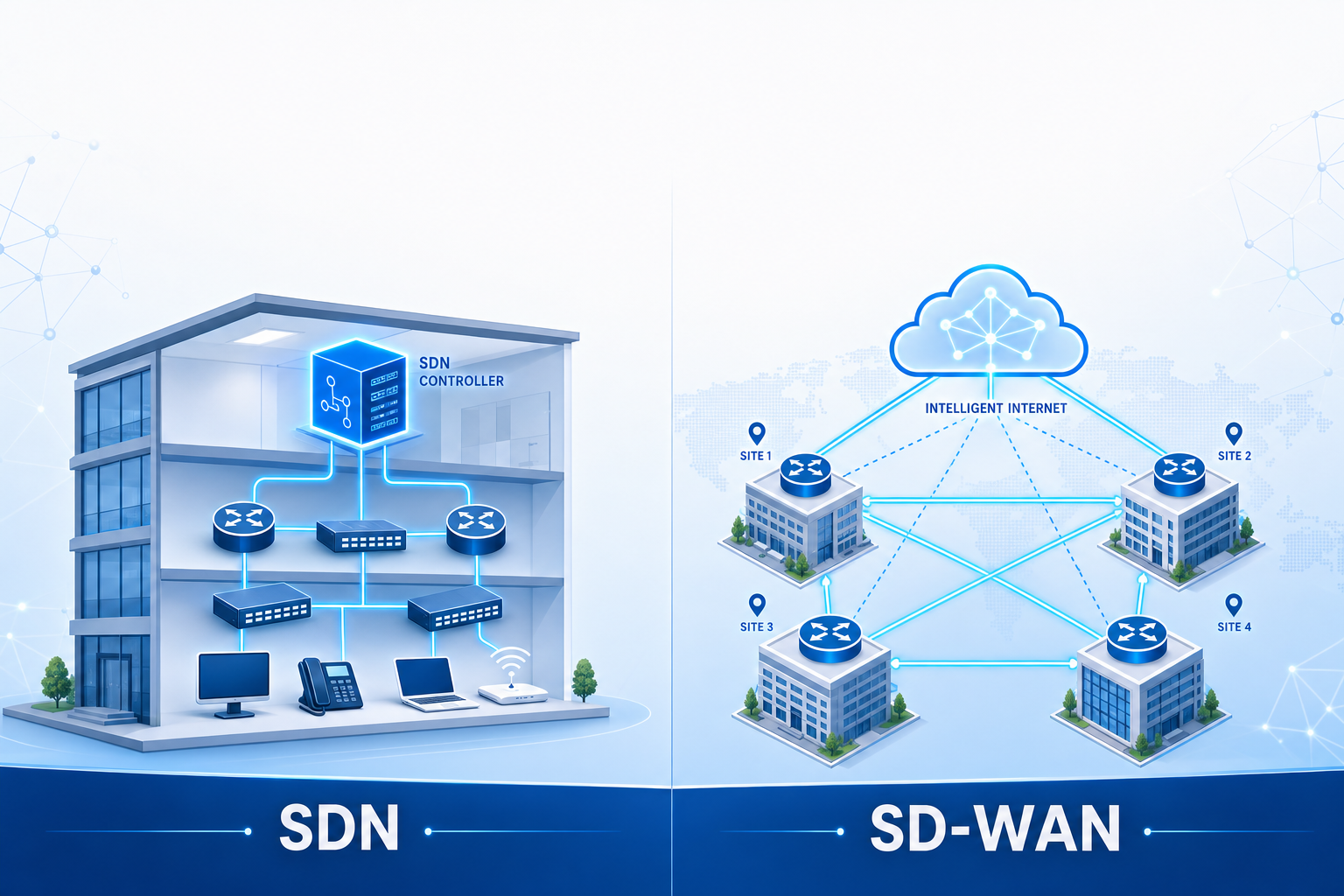
Software-Defined Networking (SDN) is a modern approach to managing computer networks through centralized software instead of configuring each network device individually.
Think about controlling every smart light in your house using a single mobile app. Instead of walking to each room to flip a switch, you make one change, and every light responds. SDN works in much the same way. A central controller manages the network, allowing administrators to make changes quickly and consistently.
Traditional networks require routers and switches to make their own decisions about traffic. With SDN, the intelligence is separated from the hardware and managed by software. This allows organizations to automate network management, improve security, and respond to changing business needs much faster.
Simple SDN Example
Imagine a large university with dozens of buildings connected to one network. During online exams, the IT department wants to prioritize internet traffic for testing applications while limiting recreational streaming.
Without SDN, administrators might have to manually configure dozens of switches and routers.
With SDN, they simply update one centralized controller, and every network device automatically follows the new policy.
What Is SD-WAN?
Software-Defined Wide Area Networking (SD-WAN) applies many SDN concepts to connecting multiple business locations.
A traditional Wide Area Network (WAN) links offices, warehouses, stores, or remote workers across cities, states, or countries. SD-WAN uses intelligent software to automatically select the fastest and most reliable internet connection for every application.
Instead of depending on one expensive private circuit, SD-WAN can combine fiber, broadband internet, LTE, and even 5G connections. If one connection slows down or fails, traffic is automatically rerouted through another available path.
Simple SD-WAN Example
Consider a retail company with stores throughout the country.
Every location needs reliable access to inventory systems, payment processing, cloud applications, and video conferencing.
If the primary internet provider experiences an outage, SD-WAN automatically switches to another available connection. Employees continue working without interruption, and customers can still complete purchases.
SDN vs. SD-WAN: What’s the Difference?
Although SDN and SD-WAN share similar technologies, they solve different networking challenges.
| SDN | SD-WAN |
|---|---|
| Manages internal business networks | Connects multiple business locations |
| Controls switches and routers centrally | Optimizes traffic across internet connections |
| Common in campuses and data centers | Common for branch offices and remote workers |
| Focuses on automation and flexibility | Focuses on connectivity, performance, and reliability |
An easy way to remember the difference is this:
SDN improves traffic inside a city, while SD-WAN improves travel between cities.
Benefits of SDN and SD-WAN
Businesses are increasingly moving applications to the cloud and supporting hybrid work environments. Traditional networking often struggles to keep up with these demands.
Both SDN and SD-WAN provide significant advantages:
- Centralized network management
- Faster deployment of new offices
- Improved network security
- Better cloud application performance
- Lower networking costs
- Easier troubleshooting
- Greater flexibility
- Reduced downtime
- Better support for remote employees
- Improved scalability as businesses grow
Real-World Examples
Healthcare
Hospitals use SDN to separate medical equipment, patient records, guest Wi-Fi, and administrative systems into secure network segments.
Healthcare organizations with multiple clinics use SD-WAN to securely connect each location while ensuring doctors can quickly access electronic health records.
Retail
Large retailers rely on SD-WAN to connect stores with headquarters while supporting payment processing, inventory systems, and surveillance cameras.
SDN simplifies the management of in-store Wi-Fi and employee devices from one central dashboard.
Education
Schools and universities often support thousands of students using laptops, tablets, and smartphones simultaneously.
SDN makes it easier to separate student, faculty, research, and guest traffic while simplifying network administration.
Multiple campuses stay connected through SD-WAN, providing reliable access to online learning platforms and cloud services.
Manufacturing
Modern factories depend on connected sensors, robotics, and industrial control systems.
SD-WAN securely connects production facilities while SDN helps IT teams manage internal factory networks efficiently.
Why SDN and SD-WAN Matter
Modern businesses rely heavily on cloud applications such as Microsoft 365, Google Workspace, Zoom, and countless Software-as-a-Service (SaaS) platforms.
As organizations continue adopting hybrid work and cloud computing, reliable networking becomes even more important.
SDN helps IT teams manage increasingly complex networks with less manual work.
SD-WAN improves performance by intelligently directing traffic across multiple internet connections, reducing downtime and improving the user experience.
For anyone starting an IT career, understanding SDN and SD-WAN provides an excellent foundation for learning cloud networking, cybersecurity, and enterprise infrastructure.
Key Terms
- Software-Defined Networking (SDN)
- Software-Defined Wide Area Networking (SD-WAN)
- Local Area Network (LAN)
- Wide Area Network (WAN)
- Router
- Switch
- Network Controller
- Cloud Computing
- Network Automation
- Quality of Service (QoS)
- Traffic Routing
- Bandwidth
- Redundancy
- Network Segmentation
- Enterprise Networking
- Zero Trust Networking
Frequently Asked Questions
Is SDN the same as SD-WAN?
No. SDN manages networks inside an organization, while SD-WAN connects multiple locations over wide-area networks using intelligent routing.
Does SD-WAN replace a VPN?
Not entirely. Many SD-WAN solutions include secure VPN capabilities, but they also provide intelligent traffic routing, centralized management, and application-aware networking.
Is SD-WAN only for large companies?
No. Small and medium-sized businesses with multiple locations or remote employees can also benefit from improved performance, reliability, and simplified management.
Should beginners learn SDN and SD-WAN?
Absolutely. These technologies are widely used in enterprise networking and cloud environments, making them valuable skills for aspiring network administrators, cloud engineers, and cybersecurity professionals.
Conclusion
Understanding SDN vs. SD-WAN for beginners doesn’t have to be difficult. SDN simplifies the management of internal business networks through centralized software, while SD-WAN intelligently connects multiple business locations using the best available network paths. Together, they help organizations improve performance, strengthen security, reduce costs, and support cloud-based applications. As businesses continue modernizing their infrastructure, SDN and SD-WAN will remain key technologies for building reliable, efficient, and scalable networks.
Whether you’re exploring networking as a career or simply expanding your IT knowledge, learning the fundamentals of SDN and SD-WAN is an excellent place to start.







Comments (0)