

Introduction
Every day, people share personal information online, businesses store customer records, and organizations rely on computer systems to keep their operations running. But what happens when sensitive information falls into the wrong hands, important files become unavailable, or someone secretly changes the data a company depends on? These situations highlight three fundamental goals of information security: Confidentiality, Integrity, and Availability. Together, these principles form the CIA Triad, a foundational concept that helps IT professionals understand how to protect information, secure computer systems, and reduce cybersecurity risks.
What Is the CIA Triad?
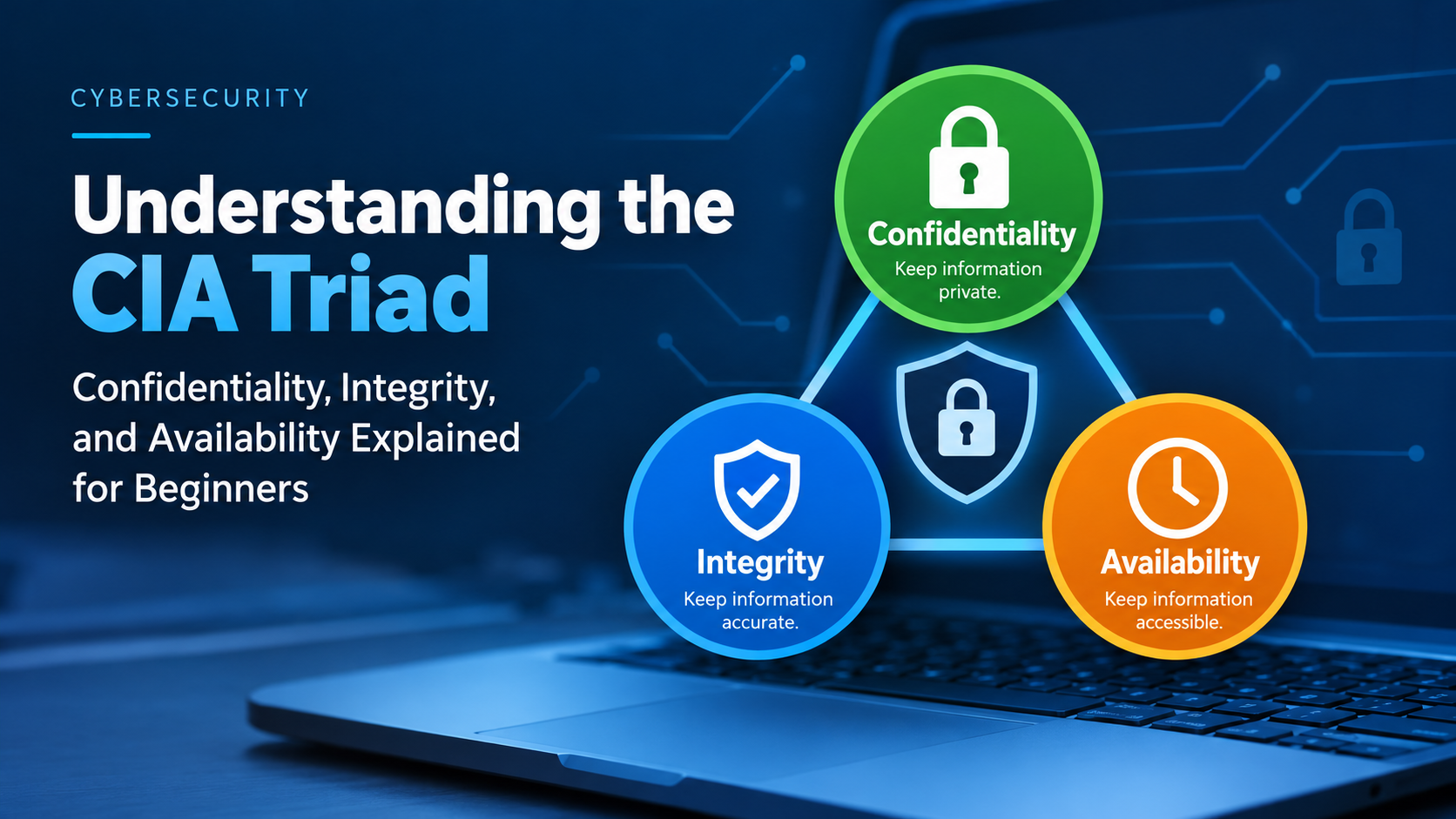
The CIA Triad is a security model that describes three essential principles for protecting information and information systems:
- Confidentiality: Ensuring information is accessible only to authorized people.
- Integrity: Ensuring information remains accurate, complete, and protected from unauthorized changes.
- Availability: Ensuring information and systems are accessible when authorized users need them.
Think of these three principles as the three legs of a stool. If one leg breaks, the stool becomes unstable. Similarly, if an organization fails to protect confidentiality, integrity, or availability, its overall security can suffer.
For example, imagine a hospital that stores patient records in an electronic health record system. The hospital must prevent unauthorized people from viewing private medical information, ensure doctors can trust that the records are accurate, and keep the system available when medical staff need it to treat patients.
Protecting only one or two of these areas is not enough. A hospital might have excellent access controls, but if its medical records are altered or its computer systems become unavailable during an emergency, patient care could still be at risk.
The CIA Triad provides a simple framework for understanding these security requirements and making better decisions about protecting digital information.
1. Confidentiality: Keeping Information Private
Confidentiality means protecting information from unauthorized access or disclosure. In simple terms, it ensures that people can only see the information they have permission to access.
Not every person in an organization needs access to every piece of information. An employee in the marketing department, for example, may need access to customer contact information but should not automatically have access to employee payroll records.
Confidentiality is especially important when dealing with sensitive information, including:
- Personal information, such as names, addresses, and Social Security numbers.
- Financial information, including bank account details and payment records.
- Medical records and other private health information.
- Business secrets, product designs, and confidential company documents.
- Usernames, passwords, and authentication credentials.
How Is Confidentiality Protected?
Organizations use several security measures to maintain confidentiality.
Access controls: Access controls determine who can view or use specific information. For example, a company may allow its human resources department to access employee records while restricting access for other departments.
Authentication: Authentication verifies a user’s identity before granting access. Common methods include passwords, fingerprint recognition, security keys, and multifactor authentication (MFA).
Encryption: Encryption transforms readable information into an encoded format that cannot be understood without the appropriate decryption key. It helps protect data stored on a computer and data transmitted across a network.
Least privilege: The principle of least privilege means giving users only the access they need to perform their assigned tasks. Limiting permissions reduces the damage that can result from compromised accounts or mistakes.
Real-World Example: Protecting Online Banking Information
Imagine logging into your online banking account. You expect to see your account balance, transaction history, and personal information, but you do not expect another customer to see those details.
Banks use authentication, access controls, encryption, and other safeguards to protect this information. If an attacker steals a customer’s password and gains access to the account, confidentiality has been compromised because someone unauthorized can now view private financial information.
A strong password and multifactor authentication can help reduce this risk. Encryption also helps protect sensitive information while it travels between a user’s device and the bank’s systems.
What Happens When Confidentiality Fails?
A confidentiality breach can lead to identity theft, financial fraud, privacy violations, reputational damage, and legal consequences.
For businesses, unauthorized disclosure of customer information can undermine trust and create significant financial costs. For individuals, it may expose sensitive details that can be used for scams or other forms of abuse.
Confidentiality is therefore not simply about keeping secrets. It is about ensuring that information is shared only with the right people for the right reasons.
2. Integrity: Keeping Information Accurate and Trustworthy
Integrity means ensuring that information remains accurate, complete, and consistent throughout its lifecycle. It also means protecting information against unauthorized or improper modification.
Information is valuable only when people can trust it. If someone changes a financial record, alters a medical prescription, or modifies a company’s inventory figures without authorization, the resulting decisions could be incorrect or harmful.
Integrity does not mean that information can never change. Legitimate updates are often necessary. Instead, integrity means that changes are authorized, appropriate, and performed in a way that preserves the reliability of the information.
How Is Integrity Protected?
Several security measures help maintain data integrity.
Access controls and permissions: Restricting who can modify information reduces the risk of unauthorized changes. Some users may be allowed to read a document without having permission to edit it.
Hashing: A cryptographic hash function produces a fixed-length value based on a file or other data. Comparing hashes can help detect whether information has changed. If a file’s contents change, its hash will generally change as well.
Digital signatures: Digital signatures use cryptographic techniques to help verify the origin and integrity of digital information. They can help recipients determine whether signed content has been altered and whether it was signed using the corresponding private key.
Audit logs: Audit logs record activities such as account access, file changes, and administrative actions. These records can help organizations investigate suspicious behavior and determine what happened to their data.
Backups and version control: Backups and version histories can help organizations restore earlier, correct versions of information after accidental or malicious changes. They support recovery, although they do not by themselves prevent unauthorized modification.
Real-World Example: Protecting Financial Records
Consider a business that uses accounting software to track its income, expenses, and payroll. The company relies on these records to prepare financial statements, pay employees, and meet its tax obligations.
Now imagine an attacker gains access to the accounting system and changes a supplier’s payment details. The company might unknowingly send money to the attacker’s account instead of the legitimate supplier.
This incident represents an integrity failure because financial information was modified without proper authorization.
To reduce the risk, the company could restrict editing permissions, require additional approval for changes to payment details, maintain audit logs, and use alerts to identify unusual activity. These controls help ensure that financial records remain trustworthy and that suspicious changes can be investigated.
What Happens When Integrity Fails?
When data integrity is compromised, organizations may make decisions based on false or incomplete information. The consequences can include financial losses, inaccurate reports, disrupted business operations, and damage to an organization’s reputation.
In healthcare, altered medical records could lead to inappropriate treatment. In manufacturing, incorrect product specifications could cause defective products. In IT operations, unauthorized configuration changes could weaken security or interrupt services.
Integrity helps ensure that the information people rely on is accurate and that changes can be properly controlled and investigated.
3. Availability: Making Information Accessible
Availability means ensuring that information, applications, and systems are accessible to authorized users when they need them.
Even if information is confidential and accurate, it has limited value if users cannot access it. A hospital needs its medical systems to be available during emergencies, an online store needs its website to accept orders, and employees need access to the systems required to do their jobs.
Availability focuses on keeping systems operational, minimizing downtime, and restoring services when disruptions occur.
How Is Availability Protected?
Organizations use several techniques to improve availability.
Redundancy: Redundancy means having backup components or systems that can take over when a primary component fails. For example, a business might use multiple servers so that one server can continue handling requests if another fails.
Regular backups: Backups allow organizations to recover data after accidental deletion, hardware failure, ransomware attacks, or other incidents. Backups should be protected from unauthorized access and tested regularly.
Disaster recovery planning: Disaster recovery plans describe how an organization will restore IT systems and data after a significant disruption, such as a fire, cyberattack, or major equipment failure.
System maintenance and monitoring: Regular updates, hardware maintenance, capacity planning, and monitoring can help identify problems before they cause significant downtime.
Distributed denial-of-service (DDoS) protection: DDoS attacks attempt to overwhelm a service with traffic from many sources, making it difficult or impossible for legitimate users to access it. Traffic filtering, rate limiting, and specialized protection services can help mitigate these attacks.
Power and network redundancy: Backup power supplies, alternative network connections, and redundant infrastructure can reduce the likelihood that a single failure will interrupt an entire service.
Real-World Example: An Online Shopping Website
Imagine an online retailer preparing for a major holiday sale. Thousands of customers visit the website to browse products, place orders, and make payments.
If the company’s servers become overloaded or a DDoS attack disrupts the website, customers may be unable to complete their purchases. Even if customer information remains private and product prices remain accurate, the business cannot operate effectively while its website is unavailable.
To reduce this risk, the retailer might use scalable cloud infrastructure, load balancing, DDoS protection, continuous monitoring, and a tested disaster recovery plan.
These measures help the company handle heavy traffic, respond to technical failures, and restore service more quickly when problems occur.
What Happens When Availability Fails?
Availability failures can lead to lost revenue, missed deadlines, frustrated customers, reduced productivity, and interrupted services.
In some environments, the consequences can be more serious. If emergency communication systems, healthcare applications, or critical infrastructure become unavailable, the disruption may affect public safety.
Availability is therefore about more than keeping computers turned on. It requires planning for failures, anticipating threats, and ensuring that essential services can continue operating or be restored within an acceptable timeframe.
How the Three Principles Work Together
The CIA Triad is most effective when confidentiality, integrity, and availability are considered together. Security measures should protect information from unauthorized access, preserve its reliability, and ensure it remains accessible to legitimate users.
Consider an online banking system:
- Confidentiality: Only authorized customers and employees can access sensitive account information.
- Integrity: Account balances and transaction records must remain accurate, and transactions must be properly authorized.
- Availability: Customers must be able to access their accounts and complete legitimate transactions when banking services are expected to be available.
A security control may support more than one principle. Encryption primarily helps protect confidentiality, but authenticated encryption can also help detect unauthorized changes to protected data. Backups primarily support availability and recovery, while protected backup records can also help restore trustworthy information.
Security decisions sometimes involve trade-offs. For example, requiring additional authentication checks may strengthen confidentiality but introduce friction for users. Strict restrictions may reduce the risk of unauthorized changes while making legitimate work more difficult if permissions are poorly designed.
The goal is not to maximize one principle at the expense of the others. It is to establish an appropriate balance based on the organization’s risks, legal obligations, operational needs, and the sensitivity of its information.
CIA Triad Comparison Table
The following table summarizes the three principles, the risks they address, and the security measures organizations commonly use to support them.
| Principle | Main Goal | What It Protects Against | Common Security Measures | Real-World Example |
|---|---|---|---|---|
| Confidentiality | Keep information private and accessible only to authorized users. | Unauthorized access, data leaks, and information theft. | Encryption, access controls, authentication, and multifactor authentication (MFA). | Preventing unauthorized users from viewing a customer’s online banking information. |
| Integrity | Keep information accurate, complete, and protected from unauthorized changes. | Data tampering, unauthorized modifications, and inaccurate records. | Hashing, digital signatures, audit logs, and file permissions. | Preventing an attacker from changing a supplier’s payment details in an accounting system. |
| Availability | Ensure information and systems are accessible when authorized users need them. | System outages, hardware failures, ransomware disruptions, and denial-of-service attacks. | Backups, redundancy, disaster recovery plans, system monitoring, and DDoS protection. | Keeping an online shopping website operational during a major sales event. |
An easy way to remember the CIA Triad:
- Confidentiality: Who can see the information?
- Integrity: Can we trust that the information is accurate?
- Availability: Can authorized users access the information when they need it?
Together, these three principles help organizations protect sensitive information, maintain reliable data, and keep essential services running.
Why Does the CIA Triad Matter?
The CIA Triad matters because it gives IT professionals a practical way to identify security risks and decide which protections are necessary.
Rather than treating cybersecurity as a collection of unrelated tools, organizations can use these three principles to understand what they are protecting and why.
Here are several reasons the CIA Triad is important.
1. It Provides a Foundation for Cybersecurity
The CIA Triad introduces the basic goals of information security. It helps beginners understand why organizations use firewalls, encryption, access controls, backups, and monitoring systems.
Each security measure should address a particular risk or support one or more security objectives.
2. It Helps Identify Security Weaknesses
Organizations can evaluate their systems by asking three straightforward questions:
- Can unauthorized people access sensitive information?
- Can information be changed without proper authorization?
- Can legitimate users access information and services when needed?
These questions help reveal weaknesses that might otherwise be overlooked.
3. It Supports Risk Management
Not every organization faces the same risks. A hospital may place significant emphasis on the confidentiality and availability of patient records, while a financial institution may have especially strict requirements for protecting transaction integrity.
The CIA Triad helps organizations identify their priorities and select security controls appropriate to their circumstances.
4. It Helps Protect Business Operations and Customer Trust
Security incidents can damage customer confidence, interrupt operations, and create financial and legal consequences. Protecting confidentiality, integrity, and availability helps organizations reduce these risks and maintain reliable services.
5. It Provides a Foundation for IT and Cybersecurity Careers
The CIA Triad is a fundamental concept for people studying networking, systems administration, information security, and cybersecurity.
Understanding it helps beginners build a foundation for more advanced topics, including security policies, incident response, access management, business continuity, and risk assessment. It is also useful when studying entry-level cybersecurity certifications.
Key Terms to Know
The following terms will help reinforce the main concepts covered in this article.
- CIA Triad: A model consisting of confidentiality, integrity, and availability that helps guide information security decisions.
- Confidentiality: Protecting information from unauthorized access or disclosure.
- Integrity: Maintaining the accuracy, completeness, and trustworthiness of information.
- Availability: Ensuring authorized users can access information and systems when needed.
- Authentication: Verifying the identity of a user, device, or system.
- Authorization: Determining which actions or resources an authenticated identity is permitted to access.
- Encryption: Transforming readable information into an encoded form that requires the appropriate key to recover.
- Hashing: Applying a function to data to produce a fixed-length value that can help detect changes.
- Digital signature: A cryptographic mechanism used to help verify the origin and integrity of digital information.
- Access control: Rules and mechanisms that determine who can access or modify resources.
- Least privilege: Giving users and systems only the permissions necessary to perform their assigned tasks.
- Multifactor authentication (MFA): Requiring two or more distinct types of authentication factors to verify identity.
- Audit log: A record of system activities that can support monitoring, accountability, and investigations.
- Redundancy: Maintaining additional components or systems to reduce the impact of individual failures.
- Disaster recovery: The processes used to restore IT systems and data after a disruptive event.
- Distributed denial-of-service (DDoS) attack: An attack that attempts to disrupt a service by overwhelming it with traffic from multiple sources.
Conclusion
The CIA Triad is one of the most important foundational concepts in information security. By understanding confidentiality, integrity, and availability, beginners can see how different security measures work together to protect information and keep systems reliable. Confidentiality keeps sensitive information away from unauthorized people, integrity ensures that data remains trustworthy, and availability helps make sure that authorized users can access the resources they need.
Whether you are securing a personal computer, managing a business network, or beginning a career in cybersecurity, the CIA Triad provides a useful framework for thinking about security risks and selecting appropriate protections. As you continue learning about IT, remember these three principles: keep information private, keep it accurate, and keep it accessible.


Comments (0)